
(Castellaño abajo)
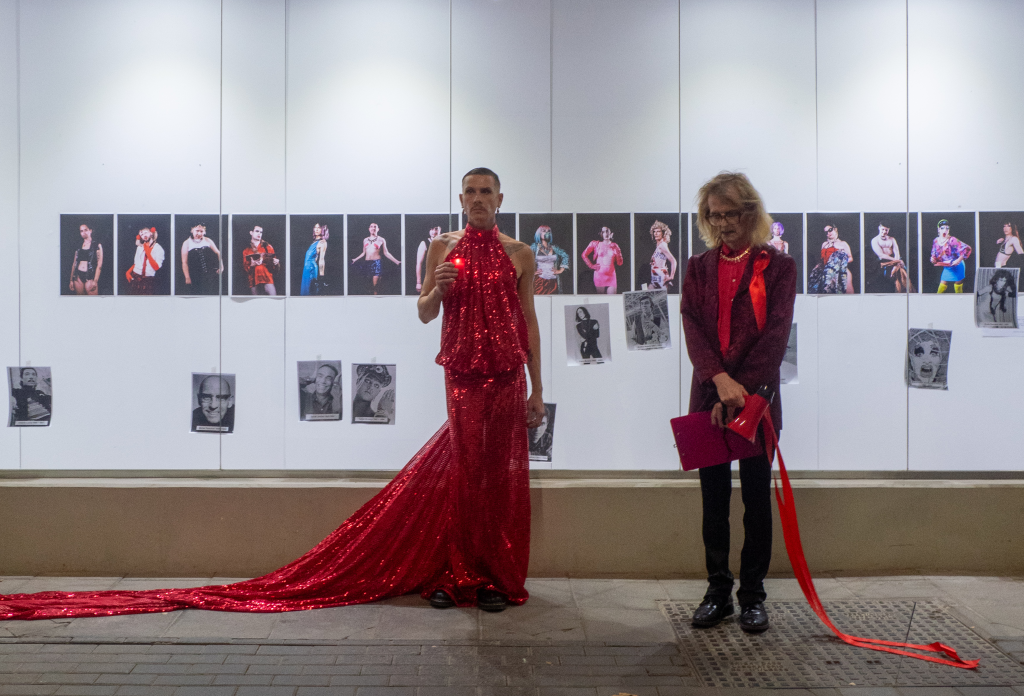
An itinerary exhibition which explores the construction of gender and sexuality from a transfeminist perspective through a series of portraits of the queer, trans and non binary community of Valencia and which draws attention to the lack of trans role models in society.
The title Queer Models refers not only to fashion models, but also to irreverent role models. These bent self-representations are the result of practical-theoretical workshops on queer resistance and representations of identity as well as performative practices related to gender and the construction of alter egos carried out by the artivist duo La Erreria (House of Bent) at the Polytechnic University of Valencia in the framework of the PC_Acts 2023 call out.
The workshops traced a genealogy of sexual and gender dissidence with a focus on the practice of radical drag, that emerged in the 70s with the sexual liberation movement and has been defined by Stuart Feather, of the Gay Liberation Front, as “a fully determined political and social provocation that confuses sex and gender rules as laid down by compulsory heterosexuality.”
In the sessions, the neutral space of a university classroom was transformed into a welcome playground for gender experimentation, using clothes, accessories, and make-up, to recreate the atmosphere of a dressing room in a cabaret. Participants were encouraged to question the binary gender system, explore their fantasies, and create multiple representations of queer identities from a process of auto-ethnography with a session of portraits taken in the photographic studio of the Fine Arts Faculty by visual artist Martin Kámen.
With the exhibition we want to share the collaborative process and the results of the workshops with a broader public to make sexual diversity visible and fight against the stereotypical and binary gender roles that oppress everyone.

The exhibition started at the UPV on the 30th of November 2023 and was extended till the 7th of April 2024 in a different exhibition space of the UPV. As part of the event we were also celebrating our 15 years of cultural agitation in the very specific local context of Valencia, a region which has seen the swing from right to left wing and back again. At this time the culture minister was an ex-bullfighter and represented an extremist right wing party so this kind of visibility was extremely important. The portraits in the exhibition witness the queer communities resilience and determination to maintain a radical stance no matter what political winds are blowing.
The exhibition opening, on the eve of World AIDS Day, also included a poignant hommage to a lost generation of queer artists, victims of a pandemic which governments paid little attention to- AIDS- and was carried out in colaboration with czech artist Martin Kamen.
“The experience of photographing the series Queer Models strengthened my belief that the LGBTQIA+ community still, perhaps more than ever, needs a so-called queer safe space. My generation and our queer predecessors lacked role models, i.e. how to navigate as a queer person in a homophobic environment, what is a chosen family, how to start the first sexual experiences and love, how to create a healthy relationship with a partner, how to accept or define yourself.
Within a queer context, there is nothing more public than privacy. For the young generation, the form of self-expression is normalized by social media, pink washing and rainbow capitalism, which of course does not improve the quality of life of real queer people or prevent uncontrollable institutional violence in public and private environments. In reality, most queer people’s process of self-identification continues to be accompanied by shame, and fear of public reaction or family acceptance. A process that very often goes hand in hand with humiliation and violence, and is therefore filled with internalized shame, anxiety, depression and sometimes suicidal thoughts.
The workshop brought together a diverse mix mainly of queer youth yearning to be themselves, excited to enjoy and shine in a communal temporary autonomous zone of Queer Safe Space. For some, to pose in front of the camera is totally natural, they were born this way. And for others it was their first studio photoshoot so we tried to find their authentic body language together, so that their portrait might speak unapologetically about their freedom of self-expression, their gender, their identity. The Queer Models series to me is not about models, but about role models for other queer kids, it is not about the world of modeling, but about the resilience of the LGBTQIA+ community as valid identities of society.” Martin Kámen
VIDEO - MAKING OF
CASTELLANO
Queer Models. Auto Re-presentaciones Torcidas
Una exposición itinerante que explora la construcción de género y sexualidad desde una perspectiva transfeminista a través de retratos de la comunidad queer/cuir, trans y no binaria de Valencia y que pone en evidencia la necesidad de generar referentes trans.
El título Queer Models no solo alude a modelos que posan, sino a referentes irreverentes. Estas auto-representaciones torcidas son el fruto de talleres prácticos-teóricos sobre resistencias y representaciones identitarias queer y prácticas performativas relacionadas con el género y la construcción de alter egos, realizados por el dúo artivista La Erreria (House of Bent) en la UPV en el marco de la convocatoria PC_Acts 2023.

Los talleres trazaron una genealogía de la disidencia sexual y de género con un enfoque en la práctica del drag radical, surgida en los años 70 con el movimiento de liberación sexual y definida por Stuart Feather, del Gay Liberation Front, como “una provocación política y social totalmente decidida que confunde las reglas de sexo y género establecidas por la heterosexualidad obligatoria”.
En las sesiones, el espacio neutro de un aula universitaria se transformó en un acogedor campo de juego para la experimentación de género, utilizando ropa, complementos y maquillaje, para recrear la atmósfera de un camerino en un cabaret. Se animó a les participantes a cuestionar el sistema binario de género, a explorar sus fantasías y crear múltiples representaciones de identidades queer desde un proceso de auto-etnografía con una sesión de retratos fotográficos realizados en los laboratorios de la Facultad de Bellas Artes por el artista visual Martin Kámen.
Con la exposición queremos compartir el proceso colaborativo y los resultados de los talleres con un público más amplio para visibilizar la diversidad sexual y luchar contra los roles estereotípicos y binarios de género que oprimen a todes.
Como parte del evento nosotres, La Erreria (House of Bent) celebramos nuestros 15 años de agitación cultural en el contexto local de la comunidad Valenciana, una región que en este tiempo ha experimentado un giro de derecha a izquierda y viceversa. En este momento la cultura estaba en manos de un ex torero de extrema derecha, entonces este trabajo es más importante que nunca. Las imágenes en la exposición son testigos de nuestra resiliencia y determinación de mantener una postura radical sin importar los vientos políticos que soplen.

La exposición empezada en noviembre del 2023, se prolongó en otro espacio expositivo de la UPV hasta el 7 de abril 2024. La inauguración tuvo lugar la noche antes del Día Mundial del SIDA e incluyó un homenaje, realizado en colaboración con el artista checo Martin Kamen, a una generación perdida de artistas queer, víctimas de una pandemia a la que los gobiernos prestaron poca atención: el SIDA (veáse vídeo arriba).
La experiencia de realizar las fotografías de la serie Queer Models reforzó mi creencia de que la comunidad LGBTQIA+ todavía, quizás más que nunca, necesita un espacio queer seguro. Mi generación y nuestros predecesores queer carecían de modelos a seguir, es decir, cómo desenvolverse como persona queer en un entorno homofóbico, qué es una familia elegida, cómo iniciar las primeras experiencias sexuales y amorosas, cómo crear una relación sana con una pareja, cómo aceptarse o definirse a sí mismo.
En un contexto queer, no hay nada más público que la privacidad. Para la generación joven, la forma de autoexpresión está normalizada por las redes sociales, el pinkwashing y el capitalismo rosa, lo que, por supuesto, no mejora la calidad de vida de las personas queer reales ni previene la violencia institucional incontrolable en entornos públicos y privados. En realidad, el proceso de autoidentificación de la mayoría de las personas queer sigue estando acompañado de vergüenza y miedo a la reacción pública o a la aceptación familiar. Un proceso lleno muy a menudo de humillación, violencia y, por lo tanto, de vergüenza internalizada, ansiedad, depresión y, muchas veces, pensamientos suicidas.
El taller reunió a una mezcla diversa, principalmente de jóvenes queer que anhelan ser elles mismes, emocionades de disfrutar y brillar en una zona temporalmente autónoma y comunitaria de un espacio queer seguro. Para algunes posar frente a la cámara es totalmente natural, nacieron así. Y para otres fue su primera sesión de fotos de estudio, así que intentamos encontrar juntes su lenguaje corporal auténtico, para que su retrato pudiera hablar sin complejos sobre su libertad de expresión, su género, su identidad. Para mí, la serie Queer Models no se trata de personas que posan, sino de modelos a seguir para otres niñes queer; no se trata del mundo del modelaje, sino de la resiliencia de la comunidad LGBTQIA+ como identidades válidas de la sociedad.” Martin Kámen

 annamariastaiano.com
You must be logged in to post a comment.